
Mitchell County Release Meaning
Mitchell County does not operate a county jail. The Mitchell County Sheriff arrests and transports people, while McDowell County Detention Facility and other prearranged jails may hold them. That split makes the word released agency-specific. A person may leave McDowell on bond, finish a jail term, receive a court-ordered release, or move to another custodian. Only the first three may place the person back in the community. A transfer to another county, the North Carolina Department of Adult Correction, the Federal Bureau of Prisons, the U.S. Marshals Service, or ICE ends one agency's custody but does not end custody as a whole.
A Mitchell County release record is therefore an event record held by the custodian that processed the exit. The Sheriff may hold the arrest and transport trail. The actual jail holds its admission ledger, booking record, release entry, and any transfer destination. A court order supplies legal authority, while the physical custodian records when that order was carried out. State prison release and supervision appear in NCDAC systems, not in a county jail list. These records work together, but they should not be collapsed into one date.
Mitchell County Release Types
The next search depends on how the custody event was classified. A bond permits release while a criminal case continues. Time served or sentence completion reflects the end of a period ordered by the court. Probation may place a person under community supervision instead of, or after, confinement. Parole and post-release supervision arise through state corrections. A dismissal can explain why a charge no longer supports confinement, yet a separate hold may still control the person's status.
| Custody event | What it means | Where to check next |
|---|---|---|
| Bond or written promise | The person leaves jail while the case remains open. | Actual jail release entry and Mitchell court case |
| Time served or sentence completion | The ordered local confinement has ended. | Judgment, jail ledger, and release summary |
| Probation | The court places the person under community supervision. | NCDAC offender record and office directory |
| Parole or post-release supervision | State prison custody ends, but supervision may continue. | NCDAC individual record and Community Supervision |
| Transfer | One custodian releases the person to another authority. | Release destination and receiving agency |
| Dismissal-related release | A charge ended, subject to any other valid hold. | Signed court document and physical release record |
Escape and death may also close an agency's custody entry, but neither is a community release in the ordinary sense. Exact labels can differ among custodians. Preserve the wording in the source record instead of converting every event into a generic release.
Note: A transfer closes one agency's custody but does not establish release from the agency that receives the person.
Mitchell County Release Record Fields
A focused request should seek existing records and fields. It should not demand that the Sheriff or jail create a custom report. Identity fields help separate people with similar names. Booking and court identifiers connect the event to the right detention episode. The release time states when one custodian's control ended, while the authority and destination show whether the person returned to the community or moved to another agency.
| Field | What it shows |
|---|---|
| Booked name and identifiers | The identity used for that detention record |
| Booking number | The specific admission episode |
| Arresting and booking agencies | Which office made the arrest and which jail processed custody |
| Admission date and time | When the custodian took control |
| Charges and court file number | The case linked to confinement |
| Bond type, amount, and status | The bond terms recorded for that episode |
| Release date and time | When that custodian's control ended |
| Release authority or type | Why custody ended at that facility |
| Destination or receiving agency | Whether the event was community release or transfer |
| Commitment or release order | The document authorizing custody or exit |
Property or account disposition and an identification photograph may exist, but access can be limited. Juvenile, medical, investigative, security-sensitive, sealed, and expunged material may be withheld or redacted under the law that applies to that record. A narrow request helps the custodian separate public fields from protected ones.
Note: Ask for the individual incarceration and release record, not an old roster that may have lost its short-term reference value.
Request Mitchell County Release Records
Mitchell County's distributed custody often requires two requests. The Mitchell County Sheriff can identify where a person was transported and provide its arrest or transport records. The actual housing jail should receive the request for its admission, release, and transfer record. If the person served a state sentence or entered state supervision, use the NCDAC public records process. Court judgments and release orders belong with the Mitchell County Clerk, not the jail.
- Match the person with a full name and another reliable identifier, such as birth date, booking number, offender number, arrest date, or court file number.
- Ask the Mitchell County Sheriff which facility held the person on the relevant date and whether its transport record shows a later move.
- Send the identified custodian a date-bounded request for the existing entry and release summary, release authority, destination, and related order.
- Request electronic PDF or JPEG copies and ask for the statutory basis if any part is withheld.
- Compare the jail event with the court order, NCDAC record, VINE event, or receiving-agency record that applies.
305 Baker Lane
Bakersville, NC 28705
828-688-3982, alternate 828-688-9974
Administrative office: Monday through Friday, 8:00 a.m. to 7:00 p.m.; agency operations are continuous.
North Carolina law sets no universal fixed response deadline. The agency must provide access and copies as promptly as possible, but review, redaction, and the size of a request affect timing. No Mitchell County release-record form or posted photo fee was located. Ordinary uncertified copies generally cannot cost more than the actual direct reproduction cost, while an unusually extensive request may support a reasonable actual-cost service charge.
Mitchell County Release Record Laws
Chapter 132 of the North Carolina General Statutes supplies the general public-record framework. G.S. 132-6 governs inspection and prompt access. G.S. 132-6.2 covers copy media and charges. The agency need not create a record that does not exist, but public and confidential information should be separated when they are mixed.
The law also has boundaries. Criminal investigative information, juvenile files, security-sensitive confinement records, and confidential correctional material can be restricted. Court records have a separate access rule. A custodian should cite the basis for withholding rather than relying on a broad claim that all jail records are private.
Mitchell County Release Record Retention
The State Archives sheriff records schedule distinguishes a durable individual record from a short-lived operational list. Its inmate incarceration record category includes entry and release summaries, arrest sheets, commitment and release orders, and related confinement records. The schedule permits destruction three years after release or transfer. That is a minimum disposition authorization, not a promise that every custodian destroys a file on the same day.
Operational accountability rosters and release reports may lose reference value sooner. That helps explain why a name can vanish from a current view while an inactive incarceration record remains available by request. Litigation, audit needs, local policy, or another hold may preserve a record longer.
Mitchell County Expunction Effects
An expunction makes an eligible state court matter confidential and removes it from ordinary public access. Mitchell petitions go through the Clerk of Superior Court at 328 Longview Drive in Bakersville. The Judicial Branch states a general petition fee of $175, with exceptions and an indigency process. Some dismissed or not-guilty matters may qualify without that general charge, while other petitions require sentence and supervision completion plus a waiting period.
A blank Portal result does not prove there was no arrest. The case may be sealed, expunged, juvenile, confidential, old, filed elsewhere, or indexed under another name. A private copy also does not vanish automatically after an expunction. When an expunction is known, do not reconstruct confidential official information from an unofficial copy.
Note: The Clerk explains court access, while the actual jail remains the source for its physical custody exit time.
Find Mitchell County Released Inmates
A reliable Mitchell County released inmate search begins by identifying the custody layer. The arresting agency, jail, court, state prison system, and federal agencies answer different questions. A name should be matched with at least one other reliable identifier. Then each timestamp should keep its label. A judge's order time, a roster update, a jail's physical exit, and a transfer intake can all differ.
- Confirm the person's identity and the Mitchell arrest or case.
- Ask the Mitchell County Sheriff which jail actually held the person on the relevant date.
- Check that custodian's current source and VINE, then ask whether an absent person was released, transferred, never booked, or held elsewhere.
- Obtain the release date, time, authority, and destination from the custodian's record.
- Search the Mitchell court case for the bond order, disposition, judgment, or release order.
- Check NCDAC for a state prison sentence or active community supervision.
- Use BOP, ICE, or federal court records only when federal custody applies.
The same-day fallback sequence is covered on the Mitchell County 24-Hour Release List page. It does not claim that a county feed exists. It shows how to replace the missing feed with direct, event-specific checks.
NCDAC Mitchell Release Search
The NCDAC Offender Public Information search covers state offenders and supervision, not people whose only custody was in a county jail. Search by offender number when possible. An inactive filter helps locate historical state records, but an out-of-prison person may remain active as a probationer or parolee. Open the individual result and read all sentence and status panels before interpreting the label.
| Search field | Use | Important limit |
|---|---|---|
| Last and first name | Basic name search | Aliases and common names require more matching |
| Sounds-like surname | Finds some spelling variations | Can broaden results substantially |
| Offender number | Most precise state identifier | Applies to NCDAC records |
| Birth date or range | Separates similar names | Must still match the record as a whole |
| Age, gender, race, ethnic group | Narrows a broad list | Use only for identity matching |
| Status | All, Active Inmate, Active Probationer/Parolee, or Inactive | Inactive alone is not a release reason |
The separate Inmate Release Search accepts a county, year, and month or surname characters. At the research date its year choices covered 2024 through 2026. A Mitchell County result there is a recent state-prison release association, not a list of people who bonded out of a jail serving Mitchell.
The official NCDAC search screen shows the filters that separate an inmate from an active probationer, parolee, or inactive record.
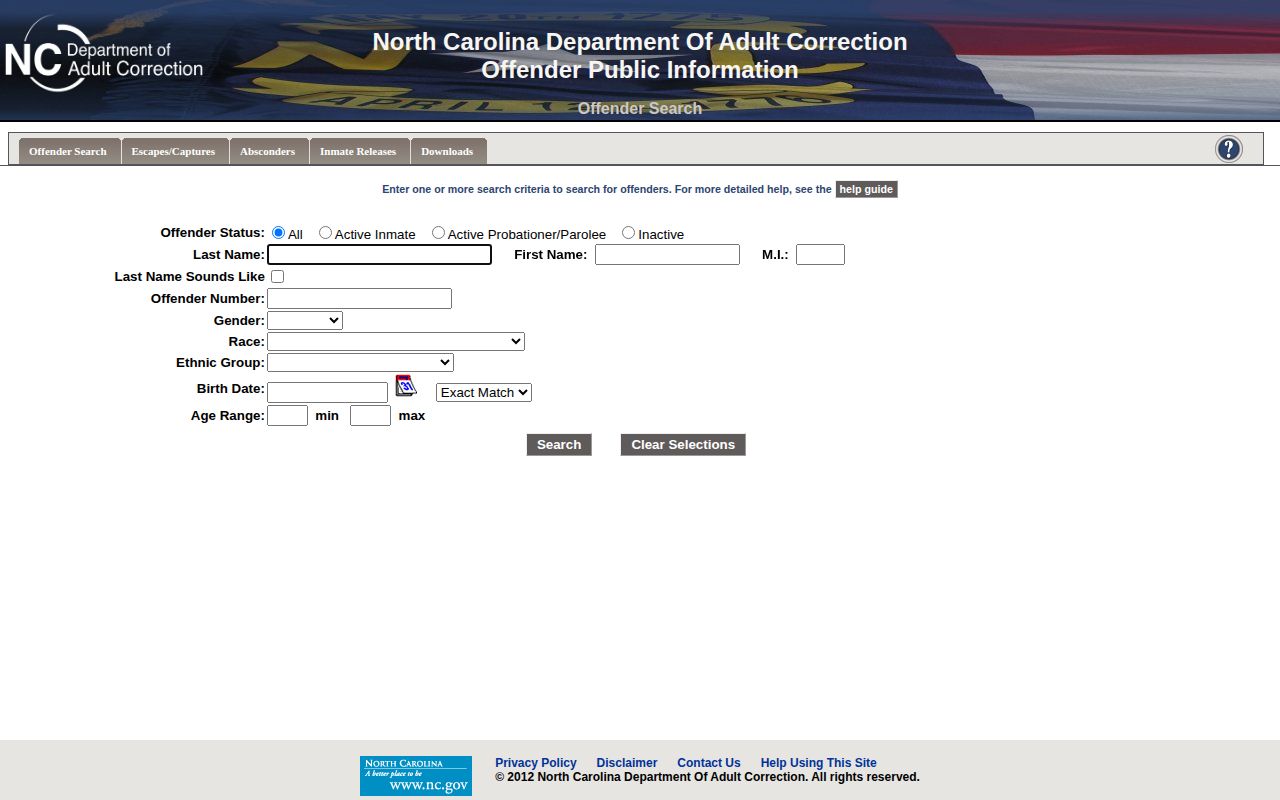
The screen is a state correctional source. It does not replace the actual jail's record for a Mitchell arrest that never entered NCDAC custody.
Note: NCDAC excludes county-jail-only records, even when the arrest and court case began in Mitchell County.
Mitchell County Recent Release Limits
The Mitchell County Sheriff publishes no official current roster, 24-hour release feed, 72-hour release feed, or released-person photo gallery. That absence follows from the lack of a Mitchell jail. McDowell County Sheriff's official iOS app expressly offers inmate search and can serve as a current-custody lead for many Mitchell arrests. Research did not establish a released tab, fixed update cadence, rolling release window, retention period, or photo field in each result.
Weekly Mitchell arrest reports republished in local news are not release lists. They can show arrests, bonds, court dates, and aggregate housing or transport facts, but they do not establish who physically left custody. Use the actual custodian, VINE, and the court record to verify the event.
Mitchell County Release Court Policy
Mitchell County is in Judicial District 35. Its pretrial release policy took effect December 1, 2025. It includes special judge-setting periods for covered domestic-violence and other cases and says the policy is kept for public inspection at each clerk's office. The policy guides release decisions, but it does not replace the order entered in one person's case.
A court event and a physical exit are separate facts. The signed order explains the legal authority. The actual housing jail records when its custody ended and whether another hold or receiving agency prevented a return to the community.
Note: The court order supplies legal authority, while the actual jail records the later physical exit or transfer.
Mitchell County Bond Release Ranges
District 35's recommended bond ranges are nonbinding. The policy lists $1,000 to $3,000 for a Class 2 misdemeanor and $3,000 to $7,500 for a Class 1 misdemeanor, while a parole warrant calls for no bond. Probation-violation recommendations span broader ranges. These figures are guidance for judicial decision-making, not an automatic price list.
No listed range promises that bond will be set, that it will be posted, or that a person will leave at a certain time. The magistrate or judge's actual order controls the legal decision. The custodian must still process that order, check other commitments or holds, and record the later release or transfer event.
Mitchell County Release Transfers
Distributed custody creates misleading disappearances. A Mitchell Sheriff report covering March 31 through April 7, 2024 said 20 Mitchell inmates were housed in McDowell County jail and prearranged detention facilities. It also recorded six inmate transports. Those dated figures prove that custody can be spread across facilities and can move. They do not show that all 20 people remained housed later or that any named person was released.
The published Mitchell Sheriff report is useful evidence of the transport model.
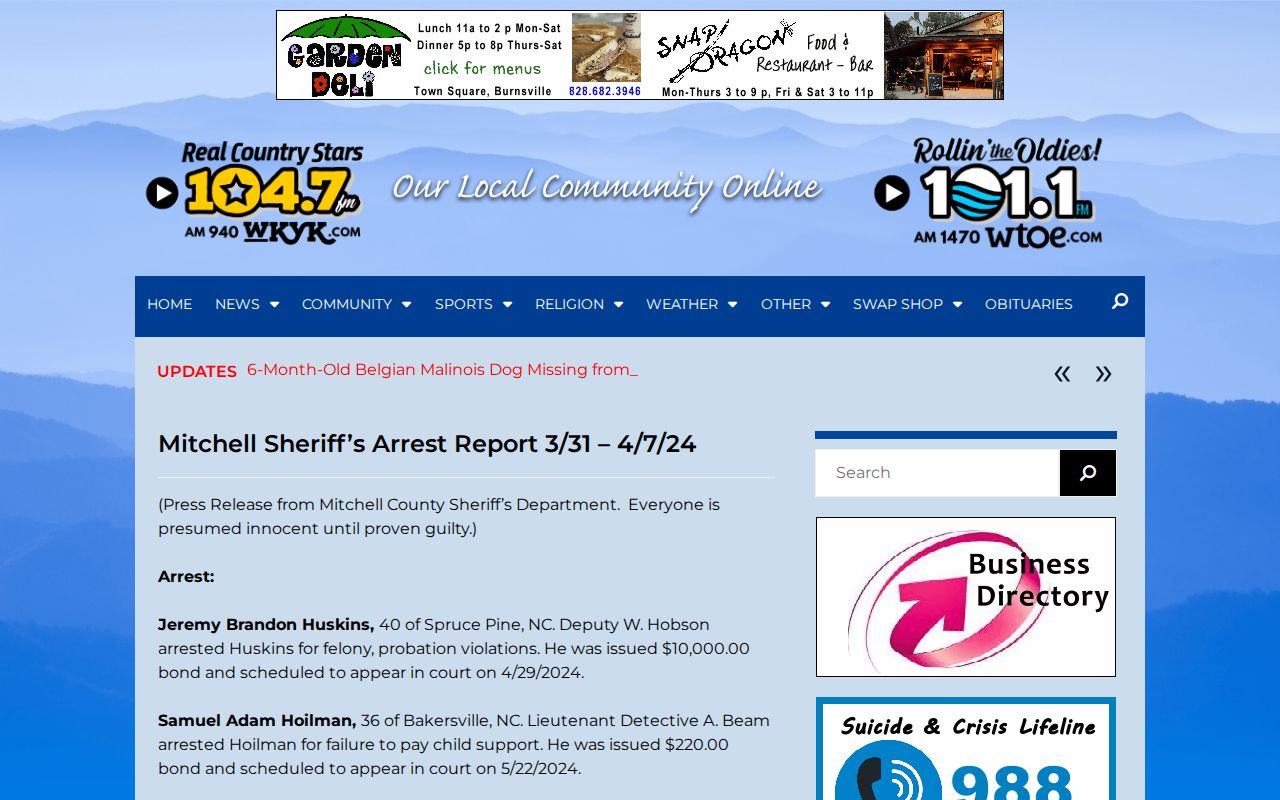
A move among McDowell and another prearranged jail is a transfer unless the release record identifies a community destination.
Getting Home After Mitchell Release
Release from a serving jail may begin outside Mitchell County. McDowell County Detention Facility is in Marion, so a return home can involve a cross-county trip. The county's 2023 assessment names Pine Line in Spruce Pine and advance-scheduled Mitchell Transit. It also reports limited on-demand transportation, especially in northern Mitchell County.
The assessment does not say either service picks up at the jail. First verify the release site and likely time with the actual custodian. Then contact the transportation provider directly about its current schedule, eligibility, reservation needs, and pickup area. A court date or projected release date should not be treated as a confirmed pickup time.
Note: Transportation sources document local options and limits, but they do not promise a ride from a release door.
Mitchell County Release Reentry Gap
The same county assessment describes a continuity gap after people return from confinement. People housed in McDowell may encounter Freedom Life Ministries, but interviewees reported that the connection did not continue when they came back to Mitchell. The assessment also identified no transitional housing or homeless shelter in Mitchell County at that time.
Those are dated findings, not a claim that no service has changed since the report. They still matter when interpreting a release plan. Physical exit, transport, treatment continuity, and stable shelter are separate needs. Current availability should be confirmed with the provider or county service office rather than assumed from a prior program contact.
Mitchell County Release System Checks
VINE, court, state, and federal sources each supply a different layer. VINELink, delivered in North Carolina through NC SAVAN, can report custody events from connected jails and Adult Correction. Read a transfer as a transfer. The eCourts Portal may show the bond order, dismissal, judgment, probation event, or other legal basis, but it usually does not provide the jail's exact physical exit time.
| Source | Best use | What it cannot prove alone |
|---|---|---|
| Actual jail record | Physical release or transfer event | Outcome of every other case or hold |
| Mitchell court record | Order, disposition, sentence, bond, or probation | Exact exit from the jail |
| NCDAC | State prison, release, and supervision status | County-only jail release |
| NC SAVAN/VINE | Connected custody event and notifications | Community release when the event says transfer |
| BOP Locator | Covered federal custody and release date | State, county, ICE, or supervision status |
| ICE ODLS | Current and recent ICE custody within its scope | A permanent immigration release history |
- Discharge
- The formal end of a sentence or supervision status recorded by the responsible agency.
- Detainer
- A notice that another authority may seek custody after the present custodian is done.
- Post-release supervision
- Mandatory state community supervision that follows certain prison terms.
- Absconder
- A person NCDAC reports as avoiding active supervision, not proof of current jail custody.
For federal records, the BOP Locator may show RELEASED, Not in BOP Custody, or a release date. ICE's Online Detainee Locator System covers current detainees and people released from ICE custody within roughly 60 days. A county release to ICE is a transfer. A later ICE release concerns ICE custody only.
Mitchell County Release Facility History
Mitchell County's no-jail condition follows a fatal jail fire on May 3, 2002. County commission minutes from 2020 discussed another feasibility study and a possible 75-bed jail and law-enforcement center. The county's 2023 assessment still stated that Mitchell had no jail. The planning discussion must not be turned into a claim that a replacement facility opened.
This history explains why the Sheriff remains a routing office while another county may hold the physical release record. It also explains why a search result for a supposed Mitchell County jail can be risky. One lookalike result concerns Mitchell County, Kansas, while similarly named McDowell sites can be private. Use the official county and agency sources.
Mitchell County Release Facilities
The correct page depends on the agency or system that controlled the relevant custody event. The first three entries describe Mitchell arrest routing and local jail housing. Avery-Mitchell is a state prison. Community Supervision concerns release into probation, parole, or post-release supervision. BOP, USMS, and ICE are separate federal layers.
- Mitchell County Sheriff’s Office: identifies the jail used and holds Mitchell arrest and transport records.
- McDowell County Detention Facility: a principal county jail for many Mitchell detainees.
- Unnamed prearranged detention facilities: variable custodians that must be identified for the date at issue.
- Avery-Mitchell Correctional Institution: an NCDAC prison whose releases appear in state records.
- NCDAC Community Supervision: verifies probation, parole, and post-release supervision.
- Federal Bureau of Prisons / U.S. Marshals Service: covers distinct federal custody routes.
- ICE detention system: covers civil immigration detention and recent ICE release within ODLS limits.
Do not infer community release from a move between these entries. The release authority and destination in the originating custodian's record provide the needed distinction.