
No Mitchell 72-Hour Release Feed
The Mitchell County Sheriff publishes no rolling 72-hour release list. Its official department page has no jail roster, recent-release view, or public archive because Mitchell County does not run a jail. A dated weekly arrest report may identify arrested people and give aggregate housing or transport totals. It does not report who left custody, the release time, the authority, or a rolling three-day window.
People arrested in Mitchell County are often housed at McDowell County Detention Facility, but the county also uses other prearranged facilities. That distributed model prevents one current list from serving as the county release ledger. McDowell’s app is relevant only after McDowell is confirmed as custodian. An app absence may mean release, transfer, a name mismatch, a system update, or housing somewhere else.
Check Mitchell 72-Hour Releases
A three-day check works best as a timeline. Begin with full name and at least one second identifier. Record the arrest date, court file number, booking number, or date of birth when known. The Mitchell Sheriff can route the inquiry to the right jail. Do not assume McDowell held every person, even though it is a principal housing facility.
- Ask the Mitchell Sheriff which jail held the person during the three-day period and whether a transport was recorded.
- Check that custodian’s official current system. For McDowell, use the official app and detention line, 828-652-2236.
- Ask for the exact custody end date and time, the release authority or type, and the destination.
- Search VINE under the correct jail identifier and note whether the event says released or transferred.
- Review Mitchell County eCourts events for the order, disposition, bond, judgment, or probation event that may explain the change.
- Check NCDAC, BOP, ICE, or another jail only when the release summary or known case path points to that system.
Write down each agency’s event time instead of forcing them into one timestamp. Court entry, jail processing, VINE transmission, app removal, transport, and physical exit can occur at different times. A same-day inquiry belongs on the Mitchell County 24-Hour Release List; the three-day method is better for reconstructing a full weekend sequence.
Mitchell 72-Hour Release Fields
There are no official Mitchell feed fields to reproduce. The useful data comes from existing records held by the arresting agency, actual jail, and court. Request the fields below from the custodian instead of asking it to produce a custom 72-hour roster. Exact labels can vary, and legally protected material may be redacted.
| Field | Role in the three-day timeline |
|---|---|
| Full booked name and identifier | Separates similar names and ties records to one episode. |
| Housing facility | Identifies the agency that had physical custody. |
| Booking and admission time | Marks the start of that custodian’s control. |
| Release date and time | Marks when that custodian’s control ended. |
| Release authority or disposition | Explains bond, time served, court release, sentence end, or other recorded basis. |
| Transfer destination | Shows whether another jail or government system received the person. |
North Carolina’s sheriff records schedule lists active and inactive inmate incarceration records, including entry and release summaries, for possible destruction three years after release or transfer. It does not promise that a public app keeps data for three days. Operational lists may lose reference value sooner. The individual record is therefore the sound fallback after a current listing changes.
Mitchell Weekend Release Reconciliation
A 72-hour window is most useful when a custody change crosses a weekend or holiday. Mitchell’s lack of a jail makes that task more complex. The arresting office may be in Bakersville, the jail may be in Marion or another county, and the court file remains tied to Mitchell County. Staff hours, record posting, transport, and notification delivery may not align. No source established a standard Mitchell or McDowell processing lag, so a fixed release promise would be false.
Start with the signed court event when one exists. Then ask the jail when it received and carried out the authority. Check whether another commitment or detainer kept the person in custody. A dismissal or time-served judgment may resolve one case while another hold controls release. If the jail gives a later physical exit time than the court order, retain both facts with clear labels.
Note: Weekend silence from an office or an unchanged app is not proof of either continued custody or completed release.
Mitchell Release Records Cross Counties
The distributed housing arrangement is documented locally. A 2024 Mitchell Sheriff report said 20 Mitchell inmates were housed across McDowell County jail and prearranged detention facilities while the office conducted six transports. Those figures describe that report period, not the current population or a release count. They show why movement must not be mistaken for community release.
The Mitchell Sheriff may hold arrest, commitment, housing, and transport records. The receiving jail holds its own incarceration ledger and physical release entry. Ask Mitchell which facility had custody on each relevant day. Then direct the release-record request to that custodian. If custody moved twice in the three-day period, obtain each agency’s event and destination. A chain of transfers can make someone disappear from more than one current roster without ever leaving government custody.
The published weekly Sheriff report illustrates the cross-county housing pattern behind many Mitchell release inquiries.
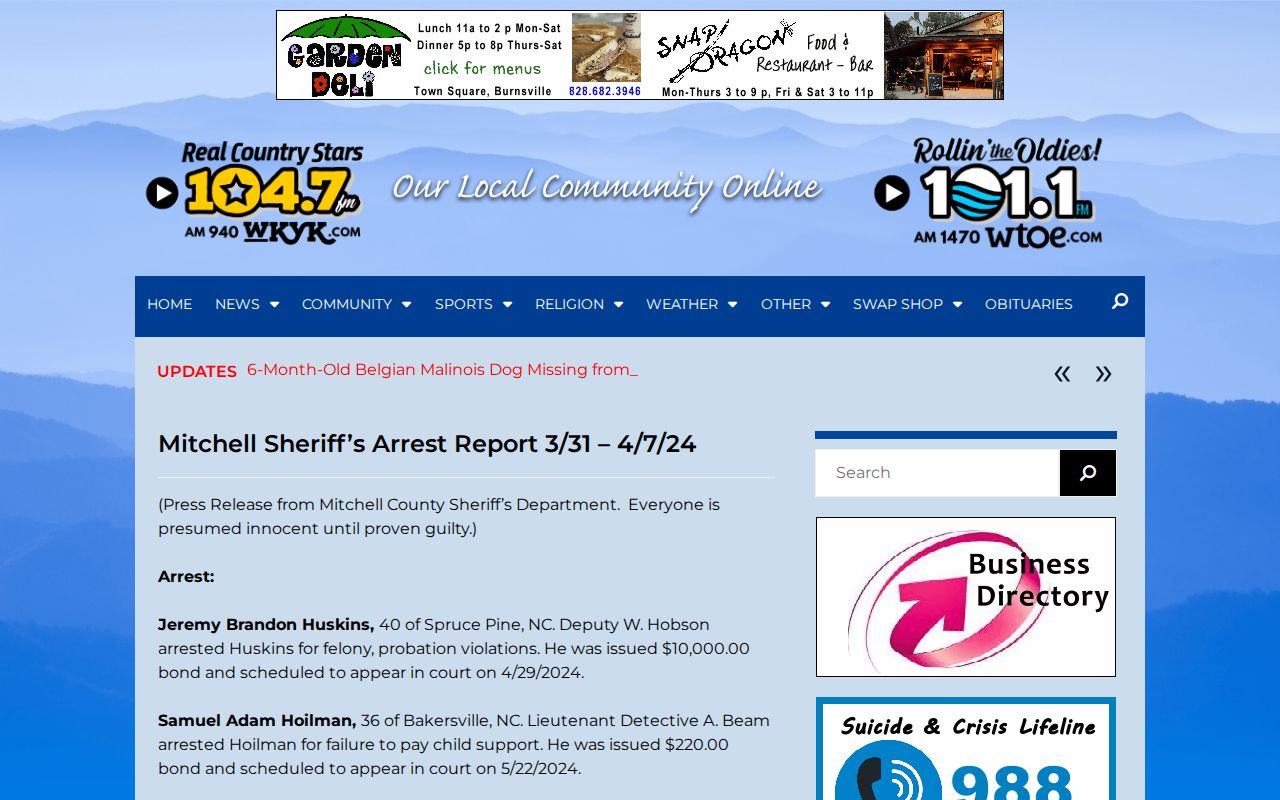
The dated report must not be relabeled as a released-person list. It provides a snapshot of inmates housed and transported, not a rolling archive of releases. Current custody still requires a fresh agency check.
Reconcile Mitchell Release Systems
VINE can report custody events from connected North Carolina jails and Adult Correction. Match the correct person, facility, and identifier. A transfer alert points to another custodian. A release alert supports the event supplied by the reporting agency, but direct confirmation still matters. Separate jail and DAC identifiers can require separate searches or registrations.
eCourts supplies the legal event, not a live location. NCDAC Offender Public Information covers state prisoners and state supervision, not people who served only in a county jail. Its Inmate Release Search uses county, month, and year for recent state-prison releases and is not a three-day Mitchell jail feed. BOP and ICE apply only to their own federal custody layers. One system’s “released” label never proves freedom from all others.
If NCDAC shows “Active Probationer/Parolee,” the person can be out of prison while still under state supervision. If it shows inactive, open each sentence panel and find the actual release or closure details. For federal custody, a BOP result marked released establishes only exit from BOP custody. ICE’s locator has a limited recent-release scope, and USMS has no comparable public name-search history. Check these routes only when the case or transfer record points there.
| Source | What it answers | What it does not answer alone |
|---|---|---|
| Actual jail | Physical custody end and destination | Every later custody event |
| eCourts | Order, bond, disposition, or judgment | Exact physical exit time |
| VINE | Agency-supplied custody event | Permanent history or all custody systems |
| NCDAC | State prison or supervision record | County-only jail release |
Request Mitchell Three-Day Records
If phone and online checks remain unclear, request the existing inmate incarceration and release record. Identify the person, approximate dates, booking or offender number, and known court file. Ask for entry and release summaries, release date and time, release authority, destination, and commitment or release orders. Request an electronic copy and allow lawful redaction. Under North Carolina public-record law, the office need not create a special three-day report that does not already exist.
Send the Mitchell portion to the Sheriff at 305 Baker Lane, Bakersville, NC 28705. Send the custodial portion to McDowell at 593 Spaulding Road, Marion, NC 28752, or to the other jail Mitchell identifies. For a state sentence, use NCDAC’s public-record route. For the signed court document, use the Mitchell Clerk. Ask each custodian to identify any withheld part and its legal basis. Public and confidential facts can exist in the same file, so lawful redaction may be used.
North Carolina law allows inspection at reasonable times and calls for copies as promptly as possible, but it sets no fixed statewide number of days. Ordinary uncertified copies generally cost no more than direct reproduction cost. Extensive use of staff or technology can support a reasonable actual-cost service charge. Ask for an electronic copy, keep the dates narrow, and obtain a cost estimate before broad work begins. When the record arrives, compare its release authority and destination with the court event and any VINE notice.
Note: No county-specific copy price or fixed response deadline was found, so ask for electronic records and a cost estimate before work begins.