
Mitchell County Projected vs Actual
“Projected release date” is NCDAC’s official phrase. It is a future estimate produced from a judgment and corrections ledger. The ledger is the agency’s running sentence calculation, including authorized credit and later changes. A projected date does not prove that a person has left custody. An actual release entry records the completed custody event and should be read with its status and destination.
These dates answer different questions. A court order may authorize release before staff complete verification, account closeout, property steps, or a transfer. A state record may project a prison date while a separate detainer permits another agency to take custody. A detainer is a request or legal basis for another authority to hold or receive the person. Release from one custodian can therefore be a transfer, not freedom.
Scheduled is not actual. Label every future date as projected, record the access date, and look later for the actual release entry and destination.
A pretrial Mitchell detainee does not have a sentence-based projection. The result turns on the judge or magistrate’s order, bond status, case events, and any other valid commitment. No source established a standard Mitchell or McDowell processing time. Do not turn a bond or dismissal entry into a promised physical exit hour.
Note: A future NCDAC date is a projection until an actual release entry and destination confirm the completed custody event.
Find Mitchell County Projected Release Dates
Start by identifying the custody layer. Mitchell County has no operating jail. A person arrested locally may be housed at McDowell County Detention Facility or another prearranged jail. A longer state sentence belongs in NCDAC. Federal and immigration custody use separate systems and dates. The arresting agency, actual custodian, and court can all hold different pieces of the record.
- Match the person with a full name plus a birth date, offender number, booking number, or court file number.
- For a state sentence, open the NCDAC Offender Public Information search. Use the offender number when known and inspect every sentence and status panel.
- Copy the projected release field exactly as displayed. Note the day the public record was checked.
- For a local sentence, ask the Mitchell Sheriff which jail held the person. Obtain the judgment, judge-certified presentence credit, holding jail ledger, and written release entry.
- Check the Mitchell eCourts case for the judgment or later correction. Use court proof for legal authority and custodian proof for physical release.
- After the projected day, find the actual release date and status. Resolve any transfer or supervision entry before describing community release.
The state search provides Last Name, First Name, M.I., Last Name Sounds Like, Offender Number, Gender, Race, Ethnic Group, Birth Date or range, Minimum Age, and Maximum Age. Its status choices include All, Active Inmate, Active Probationer/Parolee, and Inactive. A physically released person may remain active under supervision. An inactive label also needs its underlying sentence and date details.
The official search screen is shown below through the NCDAC projected-date source.
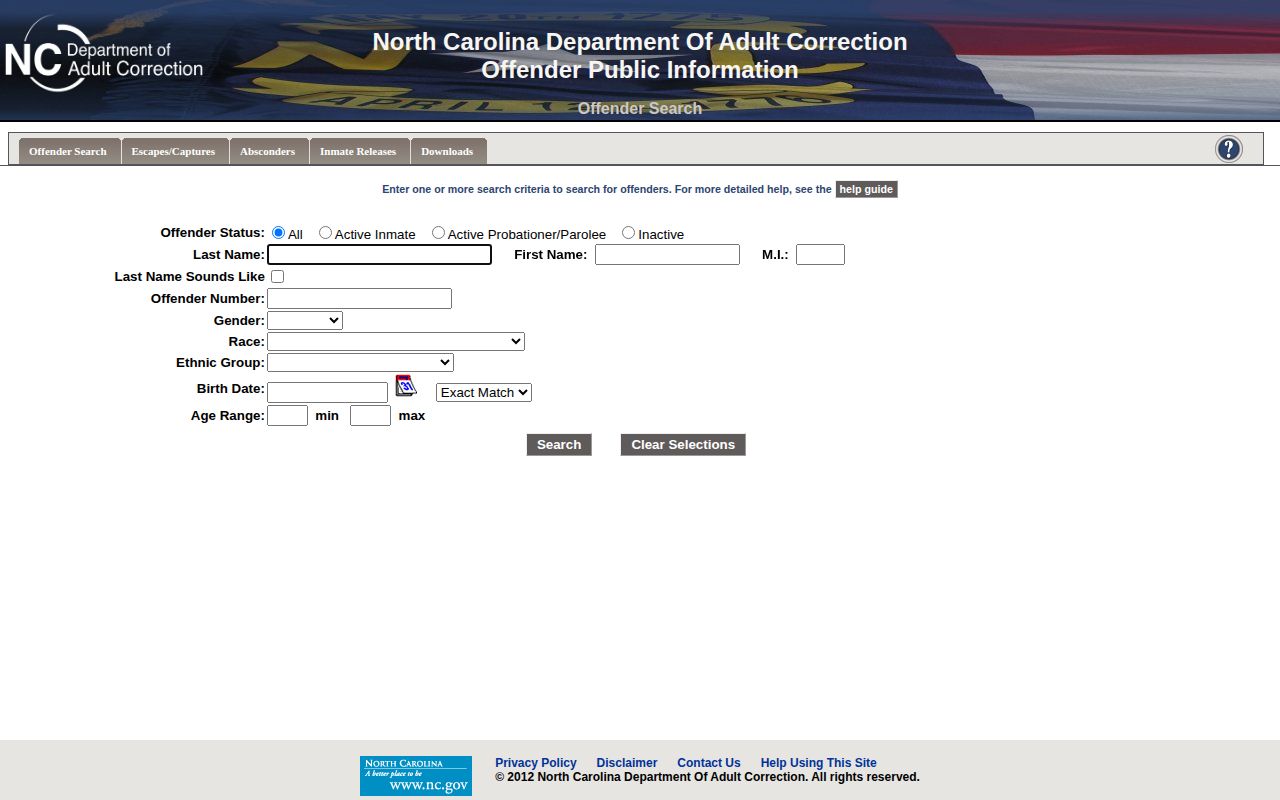
The available filters help distinguish people with similar names before any projected or actual release field is copied.
Mitchell County Felony Date Rules
North Carolina does not have a safe universal claim that every inmate serves 85 percent. For an ordinary Structured Sentencing felony, G.S. 15A-1340.13(d) requires the active offender to serve the minimum term imposed. Earned time may reduce the maximum term, but it cannot take the sentence below that judicial minimum.
Some minimum and maximum pairs can yield a rough ratio near 85 percent. That arithmetic is not the legal rule. Sentence grids, special statutes, consecutive terms, credits, and corrections events can change the relationship. For a real person, use the court’s minimum term and the corrections ledger. Do not multiply a sentence by a fixed percentage or calculate from arrest date plus sentence length.
Presentence confinement credit is another input. Chapter 15 Article 19A governs qualifying time spent in custody before judgment. The judge determines that credit for transmission to the custodian. A projected release date can be wrong if an unofficial calculation overlooks the certified credit, counts nonqualifying days, or combines concurrent and consecutive sentences incorrectly.
Note: The imposed minimum and official ledger control an ordinary North Carolina felony projection, not a universal 85 percent shortcut.
Mitchell County Misdemeanor Earned Time
Activated misdemeanor sentences use a different rule. G.S. 15A-1340.20(d) permits earned-time credit under applicable NCDAC and local-custodian rules, but combined authority may award no more than four days per month. G.S. 148-13 applies relevant state good-time and earned-time regulations to local administrators who hold sentenced jail prisoners.
This still is not a public online calculator. A Mitchell case may be housed outside Mitchell County. The actual jail’s ledger must apply the judgment, presentence credit, sentence structure, and authorized award. Ask for existing records. An agency need not create a new calculation or custom report. The final written release entry remains the proof that the projected day became an actual custody exit.
Why Mitchell Release Dates Change
A projection can move while the sentence is active. Some changes arise within corrections, while others begin with a new court action or another agency. Each change should be tied to its source rather than folded into one unexplained date.
| Factor | Effect on the projection | Best confirming record |
|---|---|---|
| Presentence credit | Certified qualifying custody time changes the ledger. | Judgment and Article 19A credit transmitted by the judge |
| Earned-time award or loss | Authorized credits can alter the date, subject to the statutory floor. | Current custodian’s sentence ledger |
| Consecutive sentences | One term follows another instead of running at the same time. | Judgments and all sentence panels |
| Corrected judgment | A court amendment can change a term or credit input. | Signed corrected order and updated ledger |
| Disciplinary event | Authorized credit loss or restoration can move the estimate. | Updated NCDAC or jail projection |
| Detainer or transfer | One custodian may release the person to another authority. | Release destination and receiving-agency record |
Parole applies only to eligible older-law and special populations. It should not be inserted as a routine date adjustment for every modern North Carolina sentence. Post-release supervision is also not more prison time. It is community supervision that can begin after the physical release date while the NCDAC record remains active.
Mitchell County Jail Date Routing
The Mitchell Sheriff is the routing office for a local arrest, not the operator of a county jail. Contact the office at 305 Baker Lane, Bakersville, NC 28705, by calling 828-688-3982 or the alternate 828-688-9974. Administrative hours are Monday through Friday, 8 a.m. to 7 p.m.; the agency operates continuously. Ask which facility held the person on the relevant date and whether Mitchell’s record shows a later transport.
If McDowell had custody, call its detention line at 828-652-2236 and request the exact release or transfer date, authority, and destination. If another prearranged jail held the person, that custodian’s ledger controls. A disappearance from the McDowell app is not a date. It may reflect release, transfer, a name variation, another jail, or a system update.
North Carolina public-record law requires records to be supplied as promptly as possible, but it sets no universal fixed-day response deadline. Request the existing entry and release summary, court commitment and release orders, and ledger information that is public. A narrow request using a full name and booking or case details is easier to route than a demand for a custom date calculation.
Mitchell County Court Credit Records
The eCourts Portal covers Mitchell County. Search by defendant name, narrow the result to Mitchell and the criminal case type, and confirm the file number. The case timeline may show bond events, a judgment and commitment, credit for time served, probation, dismissal, or a later correction. It explains the legal event but usually does not prove the jail’s physical exit time.
For the signed record, contact the Mitchell County Clerk of Superior Court at 328 Longview Drive, Bakersville, NC 28705, or call 828-688-5100. Regular hours are Monday through Friday, 8:30 a.m. to 5 p.m. Ask for the judgment and commitment, release order, bond order, dismissal, or corrected judgment by case number. Public terminals at clerk offices also support name and file-number searches.
A “time served” judgment and a release timestamp can differ because they answer separate questions. The judge determines qualifying presentence credit. The custodian processes the order and records when its control actually ends. Another hold or sentence can keep the person in custody after the Mitchell basis ends. Preserve both records rather than replacing one with the other.
Mitchell Projected Date Record Requests
When the NCDAC projection is unclear, use the department’s public-record request form. Identify the person by name and offender number and ask for existing public admission, sentence, time-served, projected-release, actual-release, and supervision fields. NCDAC may review and redact the response or provide a large production in batches. It does not have to create a new date calculation or convert its ledger into a format that does not exist.
The NCDAC records contact is 214 West Jones Street, Raleigh, with mail directed to 5201 Mail Service Center, Raleigh, NC 27699-5201. The main number is 919-733-2126. For a county sentence, send the custodial part to McDowell or the other identified jail and the arrest or transport part to the Mitchell Sheriff. The agencies should not be treated as interchangeable.
North Carolina’s sheriff retention schedule supports a written fallback after a public roster entry disappears. Inmate incarceration records include entry and release summaries, court commitment and release orders, and related confinement records. The schedule authorizes destruction three years after release or transfer. That is a minimum disposition rule, not a guarantee that every agency destroys a file on the same date. Request the individual record, not an “old roster.”
Ordinary uncertified copies generally cost no more than actual direct reproduction cost under G.S. 132-6.2. Unusually extensive technical or clerical work may support a reasonable actual-cost special charge. No Mitchell-specific projected-date or release-record fee was located. Ask for electronic PDF delivery and request an estimate before authorizing a costly production.
Confirm Mitchell County Actual Release
After the projected date, compare the official source with the executed event. For a state sentence, review the individual NCDAC record for an actual release date and current status. The separate Inmate Release Search can help with recent state-prison releases by county, month, year, or surname, but it is not a Mitchell jail feed and is not a permanent archive.
NC SAVAN/VINE can add an alert, but it does not turn a projection into proof. Register against each relevant jail or NCDAC identifier and read “released” separately from “transferred.” NCDAC Victim Support distinguishes a projection from notice of the actual date, which it may provide about 60 days before release. Neither is the final release entry.
Use the Mitchell County VINELink check for notification steps, then confirm with the custodian. If a court date, VINE event, NCDAC projection, and jail exit time differ, preserve all four with labels. The strongest conclusion joins the custodian’s release date and destination to the judgment or sentence authority.
Note: VINE notification and Victim Support notice supplement a projection but do not prove that physical release occurred.