
NCDAC Supervision After Release
NCDAC Community Supervision serves people living or reporting in Mitchell County regardless of which state prison held them. It administers probation, parole, and post-release supervision. None of those terms means that the person remains in a prison cell. An “Active Probationer/Parolee” search result confirms an active corrections relationship in the community, while the person’s sentence and release panels explain how that relationship began.
Probation is ordered by a court, often instead of active imprisonment or as the judgment permits. Parole is discretionary early release for eligible older-law and special sentences. Post-release supervision is a mandatory community period after many current Structured Sentencing prison terms. A person can move from physical custody into one of these statuses without becoming inactive in the state system.
| Status | Source | What release means |
|---|---|---|
| Probation | Court judgment | The person is supervised in the community under court-ordered terms. |
| Parole | Parole Commission action for an eligible sentence | Prison custody ends, but parole remains active until discharge. |
| Post-release supervision | Current state sentencing framework | The covered prison term moves into mandatory community supervision. |
| Inactive | NCDAC record | The label is a clue, not a full explanation; read termination and sentence details. |
Mitchell County operates no jail. A local jail release therefore may belong to McDowell County Detention Facility or another custodian and may never appear in NCDAC if the person did not serve a state sentence or enter state supervision. Keep the county release event and state supervision status separate.
Note: NCDAC Community Supervision tracks a continuing state relationship after release; it does not record a serving jail’s physical exit time.
Confirm NCDAC Supervision Status
Begin with the official NCDAC Offender Public Information search. An offender number is more exact than a name. If it is not known, use first and last name with birth date, age, sex, race, or other available filters. Search both “All” and “Active Probationer/Parolee” when physical release is known.
- Match the person with at least two identifiers. Names and aliases alone can collide.
- Open every sentence and status panel. Record the offender number, active or inactive label, and supervision type.
- Read projected and actual release fields separately. A future date is not an executed release.
- Open the current Community Supervision office directory and locate the Mitchell assignment.
- Ask the responsible office to confirm the public supervision type and office when the record is unclear.
Do not ask staff for private reporting schedules, home visits, treatment details, or other confidential case information. If NCDAC shows an active status after a jail or prison release, the records are not necessarily in conflict. One marks the end of physical custody. The other marks continuing supervision.
The official NCDAC Community Supervision overview identifies the state division responsible for these records.
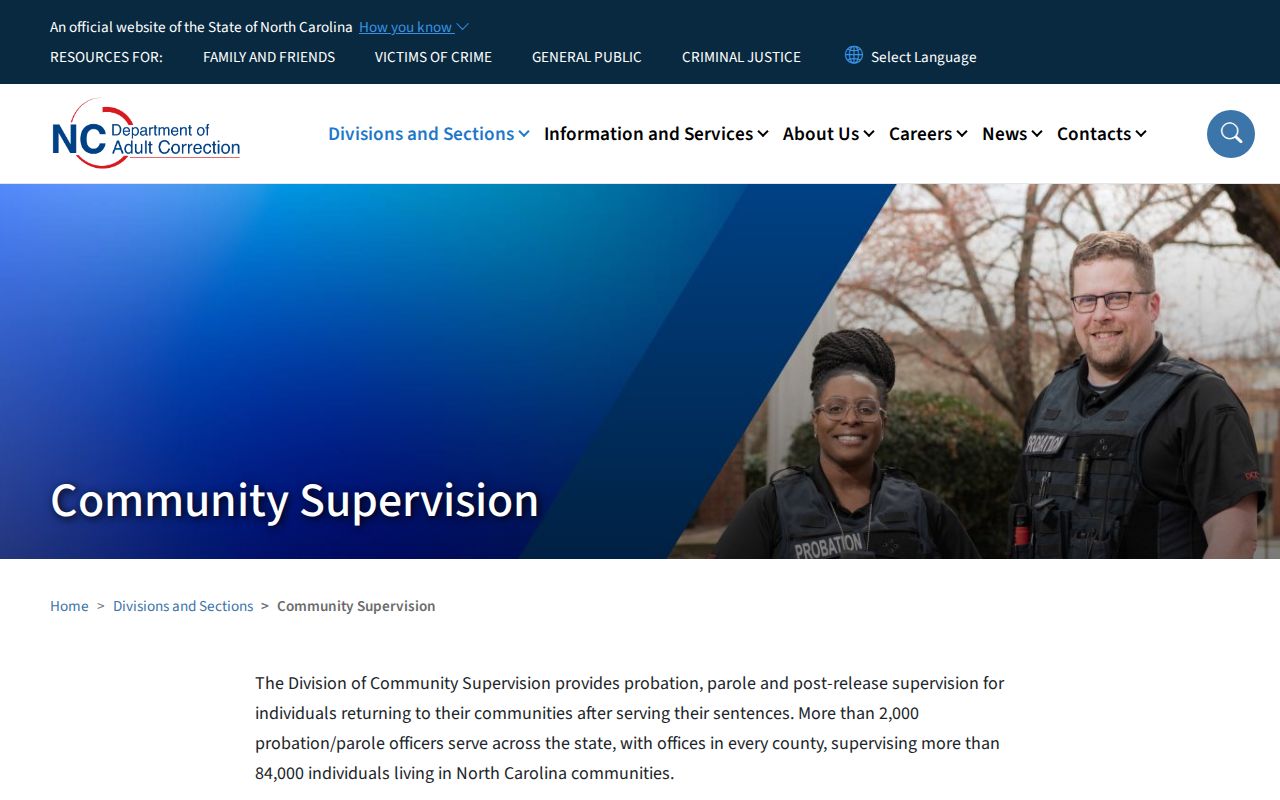
The overview establishes the system’s role, while the individual offender record and live office directory provide person-specific public routing.
NCDAC Supervision Records and Contact
Office assignments and direct numbers can change. The live directory should control instead of a copied local listing. For a public status ambiguity, provide the offender number and ask whether the person is actively supervised, which office is responsible, and whether the record reflects probation, parole, or post-release supervision.
NCDAC Community Supervision
2020 Yonkers Road
MSC 4250
Raleigh, NC 27699-4250
Phone: 919-716-3100
Fax: 919-324-6247
Current office directory
For an existing state record, use the NCDAC public-record request route. Identify the person by name and offender number and request the public admission, sentence, release, and supervision fields. NCDAC may review or redact records and may deliver a large production in batches. It does not have to create a new report or compile a custom format.
State correctional files include confidential material even though basic conviction, time-served, sentence, admission, and release information can be public. A narrow request is more accurate than seeking an entire case file. If court authority is needed, use the Mitchell County eCourts case and obtain the signed judgment from the clerk.
Mitchell County Supervision Types
NCDAC Community Supervision is a state corrections system. It does not book people, run a county jail roster, or record McDowell’s physical exit time. A Mitchell County arrest can produce several separate records: the sheriff’s arrest or transport record, the actual jail’s admission and release entry, the court judgment, and an NCDAC supervision record.
These records should form a sequence. Arrest and booking identify the custody episode. A jail or prison release entry records the end of that custodian’s control. Probation, parole, or post-release supervision can then remain active. Discharge records the later end of supervision. Mixing those events can falsely describe a supervised person as incarcerated or treat a transfer as community release.
- Discharge
- The formal end of a supervision or sentence status.
- Absconder
- A person NCDAC reports as actively avoiding supervision. It does not itself establish jail custody.
- Detainer
- A legal request or basis for another authority to hold or receive a person.
- Transfer
- A move between custodians or responsible offices, not release from every legal obligation.
The Mitchell County released inmate record path can be used when the state status must be reconciled with a local custodian and court event.
NCDAC Active and Inactive Records
“Active Probationer/Parolee” is the clearest public clue that supervision continues outside prison. It does not identify a jail cell. “Inactive” is also not a self-executing statement that every legal obligation ended on one date. Open all sentence components and look for actual release, sentence termination, supervision closure, or another status detail.
The separate NCDAC Inmate Release Search accepts county, year, and month or surname characters. At the research date it offered recent years and included Mitchell as a release-county choice. It covers state-prison releases, not people who bonded out of a serving county jail after a Mitchell arrest. Use the result to reach an individual state record, then read the supervision panel.
A Mitchell County value in that release index does not convert the tool into a local release feed. Likewise, an NCDAC absence is expected for someone who only spent time in county custody and never entered state supervision. In that case, return to the Mitchell Sheriff, actual jail, and court record.
Note: State release, supervision activation, office assignment, and supervision discharge are distinct events that may carry different dates.
Mitchell Supervision Alerts and Absconders
NC SAVAN, delivered through VINE, connects with North Carolina jails and Adult Correction, including prison, probation, and parole. Search by name or identifier, match the facility and ID, and read the event exactly. A “transfer” alert does not mean release to the community. A person moving from a jail to NCDAC can have separate identifiers, so each relevant record may require its own registration.
The NCDAC Absconder Search covers people reported as actively avoiding probation or parole supervision. Absconder status does not prove arrest or present confinement. It indicates unresolved supervision and calls for confirmation through NCDAC and the relevant official court or warrant channel.
The NC Sex Offender and Public Protection Registry is a different, offense-specific post-release channel. It is not a general supervision list. A registry entry can confirm registration information within that system’s scope, but it does not supply the latest release time or replace the NCDAC status.
NCDAC Supervision Discharge and Closure
Supervision ends through an official discharge or lawful case closure. A person should not be described as discharged merely because a result disappears or an office assignment changes. Parole eligibility is also not the same as parole discharge. North Carolina’s remaining discretionary parole rules cover eligible older-law and special populations, while current Structured Sentencing releases usually involve post-release supervision. Review the individual record for termination details and ask NCDAC for the relevant public field when the status is unclear.
The Commission’s public layer includes Monthly Discretionary Parole Reviews and required media notices for covered cases. Those sources do not replace the individual NCDAC supervision record, and Commission files are generally confidential. Read a monthly report’s own outcome language rather than assigning a generic result label. A public information meeting is also not a formal parole hearing.
Probation closure should be tied to the judgment and NCDAC termination data. A court case can show the legal order, while the corrections record shows the state supervision status. If the public panels remain ambiguous, ask for the existing public status and discharge fields instead of seeking private case-management details.
A complete Mitchell County chronology may contain a physical release date followed by an active supervision period and a later discharge. Keep those dates labeled by agency. The result is a clear record of release and community supervision without mistaking one for the other.
Note: A discharge date should be read with sentence and release fields because each marks a different stage of the corrections record.