
Mitchell Contract Release Custodians
“Prearranged detention facilities” is the phrase used in a dated Mitchell Sheriff report. It is plural, but the published material does not identify a stable and exhaustive set of partner jails. Operational needs can change which jail receives a person. Naming an unsourced permanent list would create a false trail and could send a records request to an agency that never held the person.
The useful first record is Mitchell’s date-specific transport or housing entry. Ask the Sheriff which facility received the person after arrest and whether a later transport changed the custodian. Once named, that jail becomes the source for its own admission, release, or transfer record and any intake image it holds. McDowell is a frequent option, not a default that may be assumed in every case.
Identify a Mitchell Housing Jail
Start with identity and event details that the Mitchell Sheriff can match without guessing. Give the full booked name, date of birth, approximate arrest date, arresting agency, and court file number or booking number if available. Ask where the person was booked and housed on that date. Also ask whether Mitchell later transported the person to a different agency.
- Contact the Mitchell Sheriff for the date-specific housing route.
- Write down the full official name of each receiving jail.
- Contact the named jail and verify the admission.
- Ask whether the custody end was release or transfer.
- Request the exact time, authority, and destination from the custodian’s record.
If staff report that the person was never booked there, return to the transport path rather than treating that response as release proof. A variant name, later move, or direct transfer may explain the gap. VINE can help track a reported event, but separate jail and state identifiers may require separate searches.
Note: The published source confirms multiple prearranged facilities but does not provide a fixed or exhaustive list of partner jails.
Contract Jail Release Records
Each custodian creates its own custody episode. The Mitchell arrest report may identify the original charge and officer. A transport record can show movement. The contract jail should hold the incarceration ledger and release entry for the period it controlled the person. The Mitchell court file may contain the order or judgment behind the event. No one source should be forced to answer all four questions.
| Question | Best starting source |
|---|---|
| Who made the arrest? | Mitchell Sheriff arrest record |
| Which jail received the person? | Mitchell transport or housing record |
| When did that jail’s custody end? | Named jail’s incarceration record |
| Why did the legal status change? | Mitchell court order or judgment |
| Where did custody continue? | Release destination and receiving agency |
Request existing fields such as admission time, booking number, release time, release authority, transfer destination, and commitment or release order. Ask for electronic copies when available. North Carolina law does not require a jail to create a new cross-agency spreadsheet, and confidential fields may be redacted under applicable law.
Mitchell Housing Routing Contact
The Mitchell County Sheriff’s Office is the stable point of contact even though the housing site varies. The official Sheriff page lists administration details but no jail roster or release feed. Ask for the actual custodian and Mitchell-held arrest and transport records. Then direct the incarceration request to the named jail.
Mitchell County Sheriff’s Office305 Baker Lane
Bakersville, NC 28705
Office: 828-688-3982
Alternate: 828-688-9974
Fax: 828-688-3949
Administrative hours: Monday–Friday, 8:00 a.m.–7:00 p.m.
Agency operation: 24/7
No dedicated Mitchell public-record form or posted release/photo fee was located. Under state law, ordinary uncertified copies generally cost no more than actual direct reproduction cost, while unusually extensive help can support a reasonable actual-cost special charge. Ask about cost before ordering. A narrow, individual, date-bounded request is easier to process than a demand for every historical housing contract.
Why Mitchell Contracts Housing
The distributed model traces to the fatal Mitchell County jail fire on May 3, 2002. County commission minutes in 2020 discussed a feasibility study and a possible 75-bed jail and law-enforcement center. That proposal must remain labeled as a plan. A 2023 county assessment still said Mitchell had no jail and noted that incarcerated residents were often sent to McDowell.
The absence of a local building shapes record access. Mitchell can document arrest and transport. An outside jail documents the custody episode. The court remains in Bakersville, while a longer sentence may move into NCDAC. A search that begins with a generic “Mitchell County jail” page misses this geography and risks using a private lookalike or a page about another state.
Note: A proposed replacement facility discussed in 2020 must not be mistaken for an operating Mitchell County jail.
Contract Transfers Are Not Releases
The clearest dated evidence is a 2024 Mitchell Sheriff report. It counted 20 Mitchell inmates housed in McDowell County jail and prearranged detention facilities and six inmate transports. The report proves multiple housing channels and active movement. It does not say which other jails were used, identify released people, or show community-release dates.
A person may leave one contract jail for another, move into NCDAC, or enter federal or immigration custody. Each is a transfer. The first jail’s record should show the custody end and destination, and the receiving agency should show the next admission. If the destination field is blank or withheld, ask the Mitchell transport office whether it holds the receiving-agency name.
The published weekly report is the source displayed below.
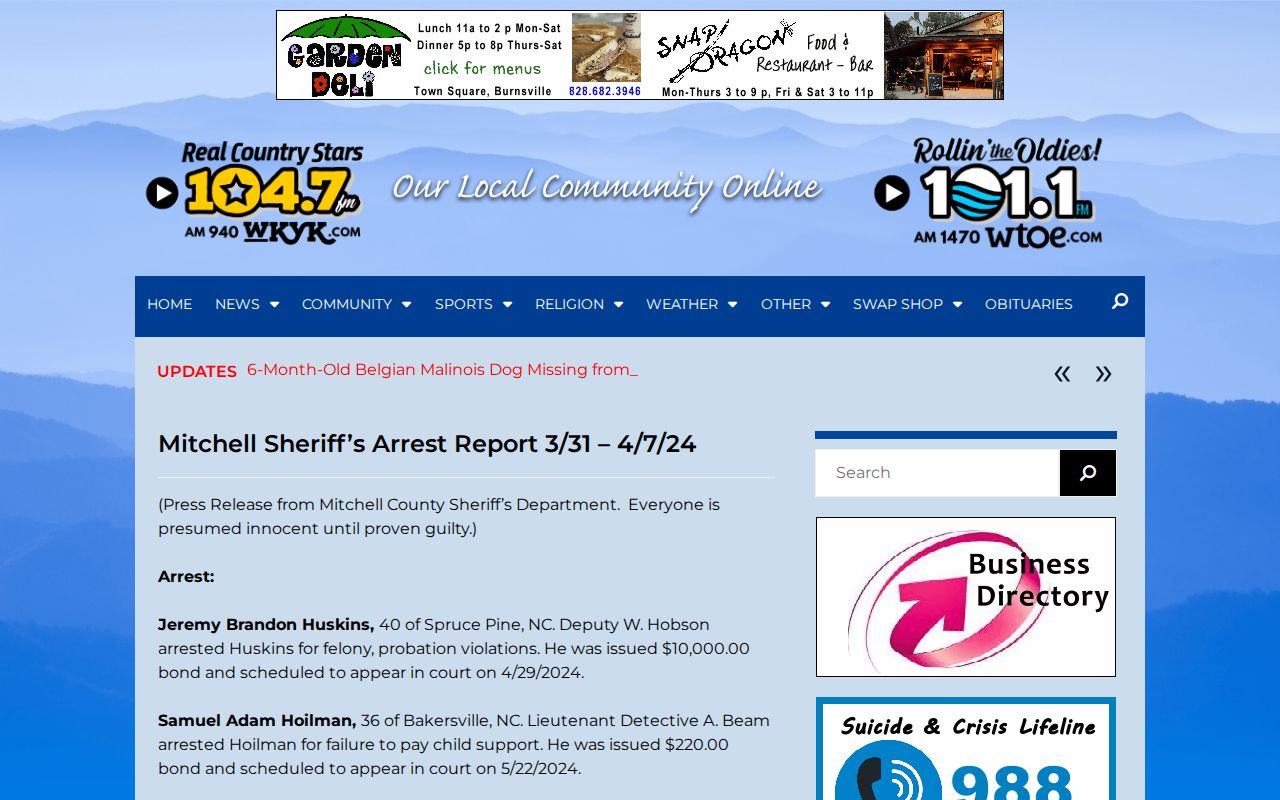
The report’s combined housing and transport counts show why a roster disappearance cannot identify the final outcome.
Prove a Contract Release
Strong proof identifies the custodian, person, custody episode, event, and destination. A name alone is weak because aliases and repeated bookings occur. Pair it with date of birth, booking number, court file number, or admission date. Preserve each agency’s timestamp as labeled. Court entry time, transport time, database posting time, and physical exit can differ.
- Community release
- The person leaves the final jail without another authority taking physical custody.
- Interfacility transfer
- The person moves between county or regional jails.
- State transfer
- NCDAC assumes custody for a prison sentence or related placement.
- Detainer transfer
- Another authority takes custody under its own legal basis.
For a community release, seek the final custodian’s release date and time plus its authority or type. For a transfer, continue the chain until the current or final custodian is found. The Mitchell County release lookup explains how court, VINE, NCDAC, and federal systems fit around that jail record without confusing their scope.
Note: The named date-specific custodian is the authoritative source for its physical release time and recorded destination.
Older Mitchell Housing Records
A current list can disappear while an inactive file remains requestable. North Carolina’s sheriff records schedule includes entry and release summaries, arrest sheets, commitment and release orders, work-release records, and pretrial-release agreements in inmate incarceration records. The schedule authorizes destruction three years after release or transfer, though holds or local retention choices may keep a record longer.
Ask for the individual incarceration record, not merely an old roster. Operational accountability lists may have shorter use because they serve day-to-day jail work. If the custodian cannot locate the record, verify the agency and date with Mitchell’s transport file. An older event could also require the court file for its legal context. Do not interpret a failed online search as proof that the episode never occurred.
Mitchell Housing Source Check
The 2020 commission minutes describe the jail history and transport burden, while the 2023 county assessment confirms that no Mitchell jail then operated. Neither source supplies a permanent contract-facility list. Use them to understand why custody is distributed, then use the Sheriff’s date-specific record to identify the actual jail for the person and event at issue.
A dated 2024 Sheriff report also counted Mitchell inmates across McDowell and prearranged facilities while documenting transports. It supports the distributed model, not a permanent roster of contract partners. The named custodian for the specific date remains the controlling source.
Reconcile Mitchell Housing Records
A Mitchell court order may explain a bond, dismissal, time-served judgment, probation sentence, or release direction. It does not identify every transport that followed or supply an unnamed jail’s physical exit time. Obtain the order by Mitchell court file number, then compare it with the Sheriff’s transport record and the actual custodian’s release entry. Each source should retain its own event label and timestamp.
If the court matter ended but the custodian will not confirm community release, ask whether another commitment, warrant, sentence, or detainer controlled the next step. The goal is to distinguish continued custody from release without seeking confidential hold details. No source establishes a fixed processing time for the distributed Mitchell system. An order time, jail posting time, transport time, and physical exit time can all differ.
Note: No researched source supports a fixed processing time between a Mitchell court order and an outside jail’s physical release.
Contract Jail Booking Photos
The jail that performed intake is normally the first place to request its booking or identification photograph. Mitchell may hold an arrest-related image, while the contract jail may hold a separate intake image. Ask the Sheriff which facility booked the person and direct the photo request to that custodian. Do not assume McDowell created the image when another prearranged jail had custody.
Photograph access is record-specific under North Carolina law. Investigative, juvenile, expunged, sealed, medical, or security restrictions can affect disclosure. Request an existing image tied to one person and custody date, prefer an electronic copy, and ask for the statutory basis for any withheld portion. The agency is not required to create a new image or recover one held solely by another custodian.